

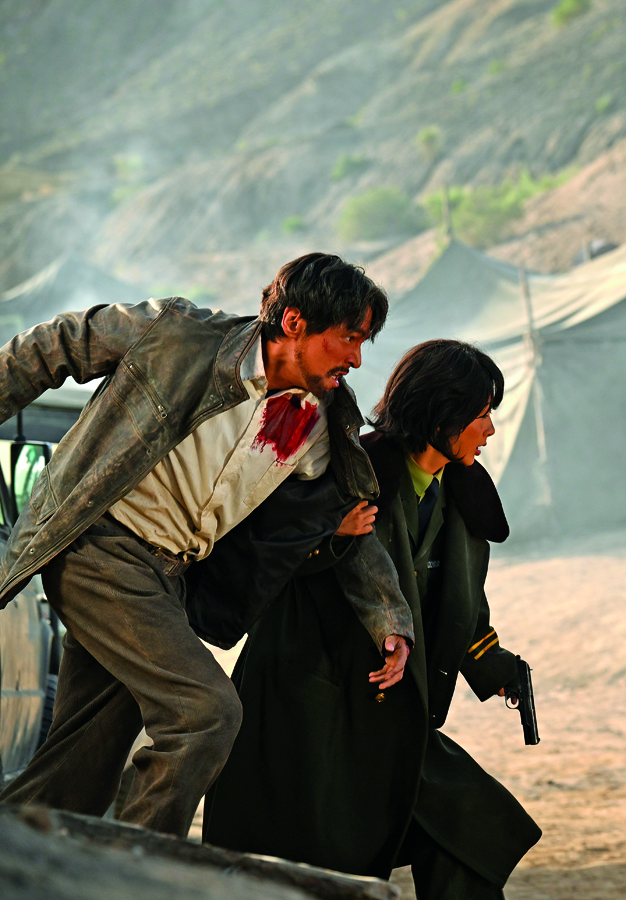
Born to Be Alive, a hit TV drama about China's efforts to fight Tibetan antelope poaching, features actor Hu Ge as a county deputy mayor and leader of a mountain patrol team, and actress Yang Zi as a police officer — who join forces to protect the highlands in Qinghai province. [Photo provided to China Daily]
Even decades later, it still makes the audience's skin crawl to witness the dangers faced by those who fought Tibetan antelope poachers.
In an early scene from Born to Be Alive — a hit television drama set in the high-altitude wilderness of Qinghai province during the 1990s — a policewoman and her companion, a mountain patroller, stop their truck in the dead of night. They fear they have accidentally struck a Tibetan antelope.
But what they find is far worse. Nearby, a herd of antelopes lies slaughtered, their bodies strewn across the frozen ground. Then the darkness ignites. Headlights from half a dozen trucks blaze to life, their beams cutting through the night. Poachers, rifles raised, have them surrounded. Gunshots ring out. The patroller collapses into a pool of blood.
As one of the most popular TV dramas this year, the program — inspired by the real-life stories of environmental defenders Sonam Dargye and his brother-in-law Drakpa Dorje, and others dedicated to the land — has amassed over 7.3 billion views of its episodes and related content since its premiere on China Central Television's CCTV-8 and streaming site iQiyi earlier this year.
An ethnic Tibetan who returned to his hometown to work as a county official, Sonam Dargye organized China's first armed anti-poaching team in 1992. Over 540 days, he and his team made 12 expeditions into the uninhabited wilds of Hoh Xil, or Kekexili, breaking up eight poaching gangs, seizing 12 vehicles, and confiscating more than 10,000 rounds of ammunition.
In 1994, he was ambushed while escorting captured poachers. After a fierce gunfight in which he faced 18 armed criminals alone, he was fatally shot. After his death, Drakpa Dorje carried on his legacy, reorganizing the team and naming it the "Wild Yak Brigade" — a name symbolizing that despite yaks being gentle-natured animals, they will fight back fearlessly if their territory is invaded.
The TV series stars actor Hu Ge as Dorje, a county deputy head inspired by the two real-life heroes, and actress Yang Zi as Bai Ju, a police officer tasked with escorting captured poachers and handling logistics for Dorje's mountain patrol team. After initial misunderstandings, the two grow closer and join forces with fellow team members to track down poachers. However, tragedy strikes when Dorje goes missing during a mission, prompting Bai to embark on a 17-year journey to uncover the truth behind his disappearance.
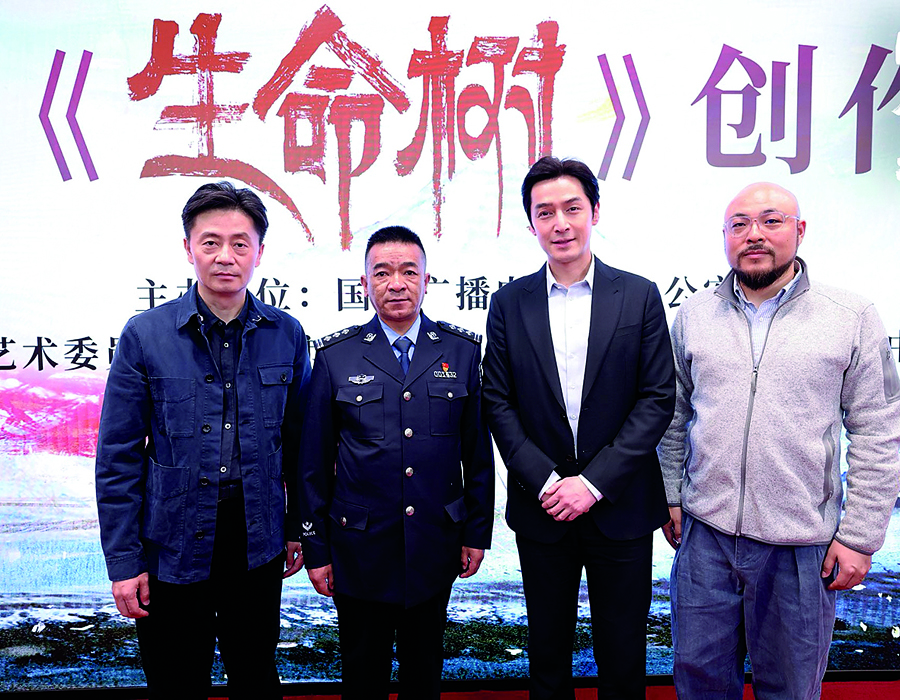
A seminar about the drama was held in Beijing on March 11, attended by its creators, including director Li Xue (left) and actor Hu Ge (second right). [Photo provided to China Daily]
For director Li Xue, visiting the former residence of Sonam Dargye in Zhidoi county, Yushu Tibetan autonomous prefecture, Qinghai province, felt like a journey through time — a chance to "meet" the revered hero.
Situated at an average altitude of more than 4,500 meters, the county lies near Hoh Xil, China's largest and highest uninhabited region, home to rare wildlife such as Tibetan antelopes and wild yaks. Because of the harsh natural conditions — low temperatures and scarce rainfall — tall trees are rarely seen.
Yet Li was surprised to find a tree nearly three stories high standing in the yard, said to have been planted by Sonam Dargye himself about 40 years ago.
The tree had grown straight through the roof of a greenhouse — a stubborn, tenacious miracle of life reaching toward the sky. Standing there, Li felt overwhelmed, as if time had folded in on itself. It was as though he were standing beside Sonam Dargye, whose story now survives only in written or video records and the memories of local elders.
Later, during the creative process, that moment — etched deep in his mind — gave the director a sudden inspiration: to plant a similar tree in the residence of Zhang Qinqin, a local hospital president whose real-life prototype is Han Mei, Dargye's classmate at their primary school and college.
Serving as a metaphor for inheritance, the tree is woven into a new storyline. In the series, it is cared for by Bai Ju, who gradually develops a student-mentor relationship with Dorje.
Through a lot of preparation, including immersing himself in Zhidoi county for a month and interviewing local experts, Li says he learned a great deal from local residents, insights that helped ground the drama in real details. He has also watched director Peng Hui's 2000 documentary Balance and director Lu Chuan's 2004 film Kekexili: Mountain Patrol many times — two iconic works about China's efforts to battle Tibetan antelope poachers.
All these have inspired the drama. For instance, when venturing into Hoh Xil, patrol teams must bring essentials such as oil and tents by truck, but rarely vegetables, which freeze quickly in the extreme cold and turn bitter.
"The patrol members never carried drinking water. Instead, they fetched water from rivers or collected rainwater that had gathered in holes in the ground. If their vehicle's wheels became stuck in the mud, they would lay quilts under the tires to push it out," recalls Li, adding that even though the quilts became filthy, they still had to wrap themselves in them to keep warm.
Li also learned that poachers would bury Tibetan antelope hides in a designated spot, only revealing the location after negotiating a price with smugglers. Once unearthed, the hides would be smuggled to Nepal or India — hidden inside clothing or mixed in with ordinary sheep wool. It takes the lives of three to five Tibetan antelopes to make a single shahtoosh shawl, which fetches a high price on the international market. This buried-hide detail is also depicted in the drama.
Leading a crew of around 700 members over 180 days of filming across multiple locations in Qinghai province and the Inner Mongolia autonomous region, Li says he was deeply moved by the warmth and openness of the Tibetan locals.
"Tibetan people have a unique outlook on life and death — they hold all life in reverence, believing that even a blade of grass or a stone possesses a spirit, let alone the Tibetan antelope," he says.
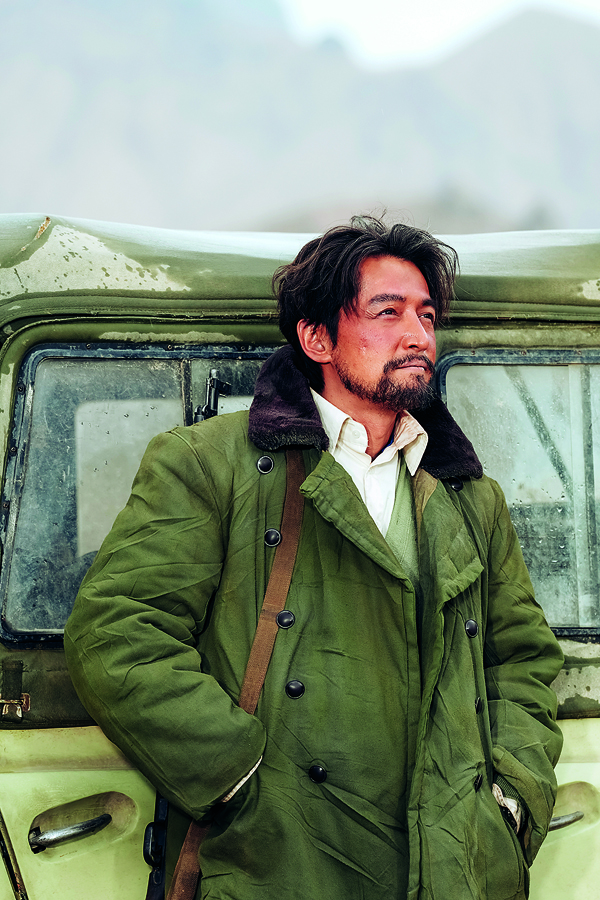
Born to Be Alive, a hit TV drama about China's efforts to fight Tibetan antelope poaching, features actor Hu Ge as a county deputy mayor and leader of a mountain patrol team, and actress Yang Zi as a police officer — who join forces to protect the highlands in Qinghai province. [Photo provided to China Daily]
Actor Hu Ge, who has volunteered with Green River — an influential environmental NGO — since 2013, was a natural fit for the role, thanks to his years of hands-on involvement in environmental and wildlife protection.
"For more than a decade, we have protected bar-headed geese, picked up trash along the Qinghai-Tibet Highway, and even argued with companions over whether we should carry out our toilet paper after relieving ourselves in the wild. These experiences were never 'material' for a performance — they are life experiences etched into my very being," Hu says, reflecting on his deep connection to the character.
He also reveals that during the filming of Born to Be Alive, he gained a deeper understanding of the relationship between humankind and nature.
"The core of environmental protection is actually not about what you do, but what you choose not to do — not to intervene. Curiosity and lenses, even when motivated by kindness, can be a disturbance to wild creatures. That sense of awe toward nature was the top priority for the crew throughout the six-year production process," says Hu.
Today, the population of Tibetan antelope in Hoh Xil has rebounded to more than 70,000, up from fewer than 20,000 in the early 1990s. Dai Qing, a film and television professor at the Communication University of China, says that the series profoundly reflects China's efforts in exploring the balance between modernization and environmental protection, adding that it will help enhance the country's cultural image overseas.

Born to Be Alive, a hit TV drama about China's efforts to fight Tibetan antelope poaching, features actor Hu Ge as a county deputy mayor and leader of a mountain patrol team, and actress Yang Zi as a police officer — who join forces to protect the highlands in Qinghai province. [Photo provided to China Daily]
 Editor:Cai Xiaohui

